ShockWave Therapy
Shockwave Therapy
Helping Chronic Injuries Heal Again
Many injuries heal on their own. Others seem to get "stuck." They may feel better for a while, but the tissue never fully repairs itself, leading to recurring pain and stiffness.
Shockwave Therapy is designed to help break that cycle.
Using powerful acoustic (sound) waves, Shockwave Therapy creates tiny, controlled amounts of mechanical stress within damaged tissue. This microscopic stimulation encourages your body to restart its natural healing response, increasing blood flow, stimulating cell activity, and promoting the formation of healthier tissue.
Unlike surgery or injections, Shockwave Therapy is completely non-invasive and requires little to no downtime.
What Conditions Can Shockwave Therapy Treat?
Shockwave Therapy is commonly used for chronic tendon, ligament, muscle, and fascial injuries that haven't healed completely.
It may help with:
These injuries often linger for months because the body has slowed or stopped actively repairing the damaged tissue.
Conditions We Commonly Treat with Shockwave Therapy
🧠 Head – Tension Headaches (muscular)
💪 Shoulder – Rotator Cuff • Calcific Tendinitis
💥 Elbow – Tennis & Golfer's Elbow
🦵 Hip – Gluteal Tendinopathy • Bursitis
🦿 Knee – Jumper's Knee • IT Band
👣 Foot – Plantar Fasciitis • Achilles • Heel Pain
Complete list below
Restarting the Healing Cycle
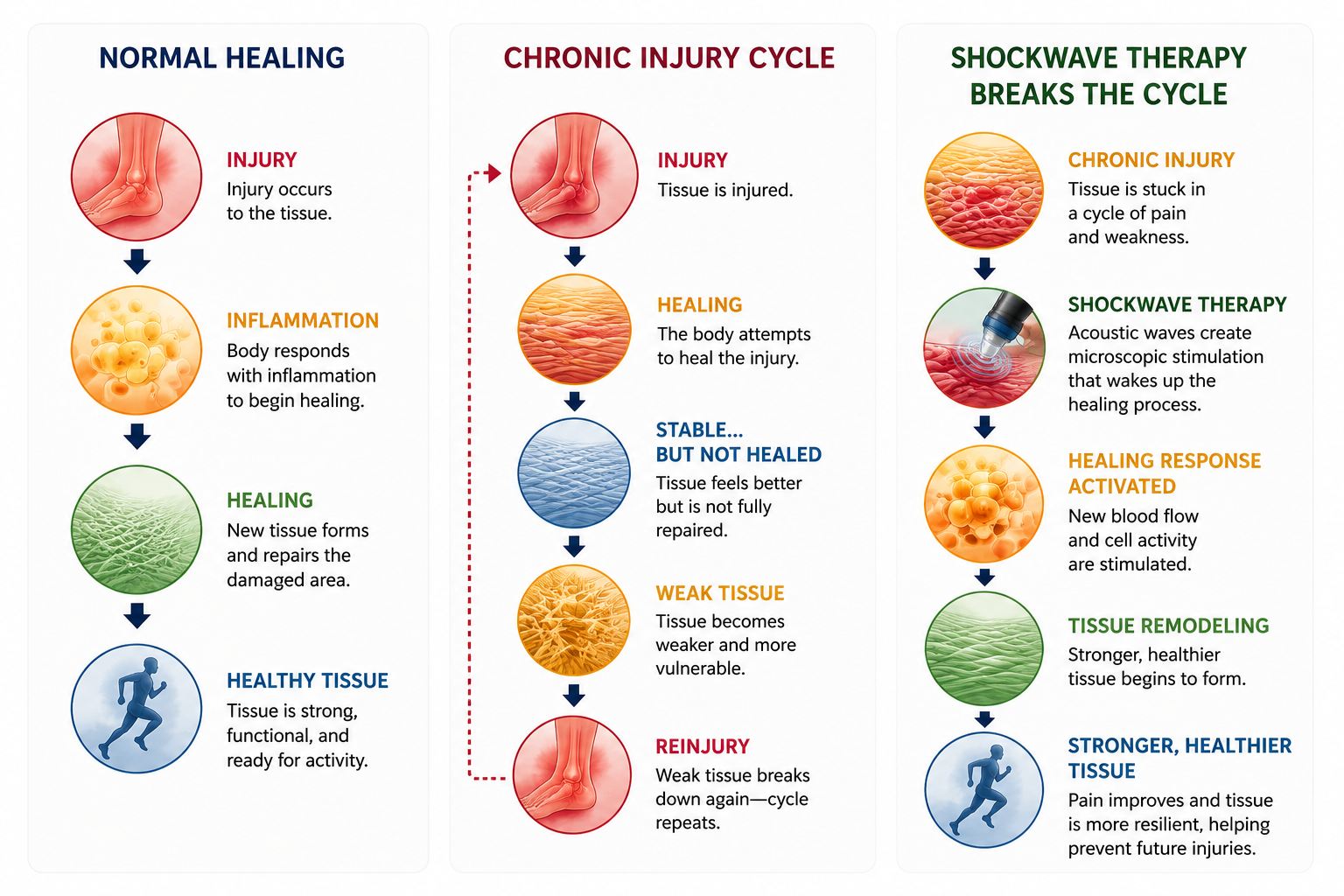
When you sprain an ankle or strain a muscle, your body naturally goes through several stages:
Injury → Healing → Repair → Strong Tissue
With chronic injuries, however, that process doesn't always finish. The tissue may become stable enough to function but never completely heals. Over time it becomes weaker, less flexible, and more painful, making it easier to injure again.
Many chronic injuries follow a pattern like this:
Injury → Healing → Stability → Weakness → Reinjury
Shockwave Therapy helps interrupt this cycle.
The acoustic waves create tiny amounts of controlled mechanical stress within the damaged tissue. This stimulates your body's healing response again—without creating a new injury—allowing the tissue another opportunity to remodel and strengthen.
Think of it as giving your body's repair crew another chance to finish the job.
Why Multiple Treatments?
Healing doesn't happen overnight.
Each Shockwave Therapy treatment stimulates another healing response. As your body lays down healthier collagen fibers and improves circulation, the tissue continues to remodel between treatments.
Most patients benefit from 5–10 treatments, typically performed once per week. Each session builds upon the previous one, gradually improving tissue quality, reducing pain, and restoring normal function.
The goal isn't simply to reduce pain for a few days—it's to help create stronger, healthier tissue that stays healthy long after treatment is complete.
Why Patients Choose Shockwave Therapy ?
✔ Non-surgical
✔ Drug-free
✔ No injections
✔ Treatments take about 10–15 minutes
✔ Little to no downtime
✔ Encourages your body's natural healing process
✔ Can reduce chronic pain while improving strength and function
Appointments Available Daily
More Conditions Shockwave Therapy Can Treat
Foot & Ankle
Plantar Fasciitis
Achilles Tendinopathy
Heel Spurs (associated with plantar fasciitis)
Chronic Ankle Sprains
Peroneal Tendinopathy
Posterior Tibial Tendon Dysfunction
Metatarsalgia
Shoulder
Rotator Cuff Tendinopathy
Rotator Cuff Partial Tears
Calcific Tendinitis
Shoulder Impingement Syndrome
Biceps Tendinopathy
Frozen Shoulder (Adhesive Capsulitis)
Deltoid Trigger Points
Lower Back
Chronic Lumbar Muscle Strains
Thoracolumbar Fascia Dysfunction
Quadratus Lumborum Trigger Points
Chronic Paraspinal Muscle Tightness
Gluteal Trigger Points
Knee
Patellar Tendinopathy (Jumper's Knee)
Quadriceps Tendinopathy
Pes Anserine Tendinopathy
Iliotibial (IT) Band Syndrome
Patellofemoral Pain Syndrome
Osgood-Schlatter Disease (persistent cases)
Hand & Wrist
De Quervain's Tenosynovitis
Trigger Finger
Wrist Tendinitis
Thumb Tendinopathy
Sports & Performance Recovery
Muscle Strains
Ligament Sprains
Scar Tissue
Post-Surgical Scar Tissue (once cleared by the surgeon)
Delayed Healing Tendons
Chronic Overuse Injuries
Repetitive Stress Injuries
Elbow
Tennis Elbow (Lateral Epicondylitis)
Golfer's Elbow (Medial Epicondylitis)
Distal Biceps Tendinopathy
Triceps Tendinopathy
Hip & Pelvis
Greater Trochanteric Pain Syndrome
Gluteus Medius/Minimus Tendinopathy
Hamstring Tendinopathy
Hip Flexor Tendinopathy
Adductor (Groin) Strains
Proximal Hamstring Pain
Chronic Piriformis Syndrome*
Chronic SI Joint Muscle Dysfunction*
(*when muscular or tendon involvement is contributing)
Neck & Upper Back
Chronic Muscle Tightness
Myofascial Trigger Points
Upper Trapezius Tightness
Levator Scapulae Pain
Occipital Muscle Tension
Cervicogenic Headaches (muscular component)